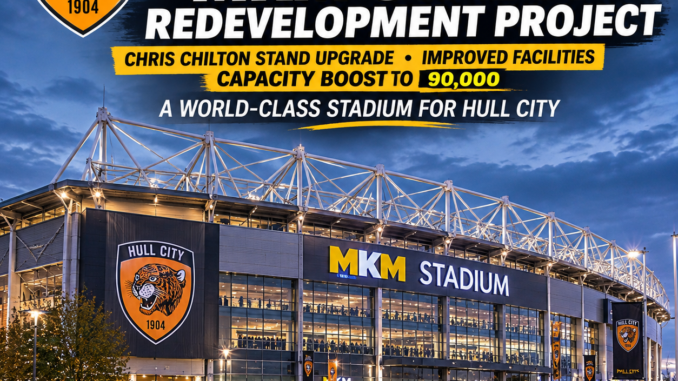
Hull City Unveils Monumental $2 Billion Plan to Transform MKM Stadium into a 90,000-Capacity Arena
KINGSTON UPON HULL, England — In a watershed moment for English football and the city of Kingston upon Hull, Hull City owner Acun Ilicali has unveiled an audacious $2 billion redevelopment blueprint that will completely reimagine the MKM Stadium. The landmark project, designed to elevate the venue into one of the largest and most technologically advanced football arenas in the world, will see the stadium’s capacity skyrocket from its current 24,983 to a staggering 90,000 seats.
At the heart of the architectural overhaul is a massive expansion of the historic Chris Chilton Stand, alongside sweeping upgrades to concourses, hospitality suites, and surrounding community infrastructure. If realized on schedule, the revamped MKM Stadium will match London’s Wembley Stadium in scale, instantly becoming the largest club football ground in the United Kingdom and placing Hull firmly on the global sporting map.
Since completing his takeover of the Tigers in January 2022, Turkish media mogul and entrepreneur Acun Ilicali has made no secret of his ambition to restore Hull City to the upper echelons of English football. Following the club’s recent return to the Premier League, Ilicali stated that off-pitch infrastructure must match the club’s on-pitch trajectory.
“When I first arrived in Hull, I spoke about dreaming big and building something truly special together with our incredible supporters,” Ilicali said in a statement accompanying the announcement. “This $2 billion investment is not just about building a bigger stadium; it is about creating a world-class landmark for the people of Hull, East Yorkshire, and football fans across the globe. We want the MKM Stadium to stand shoulder to shoulder with the greatest sporting venues on earth.”
Opened in December 2002 at an original cost of approximately £44 million, the MKM Stadium has long been praised for its unobstructed sightlines and intimate bowl atmosphere. However, its asymmetrical design—featuring a two-tiered West Stand alongside three single-tier sections—has historically capped attendance just shy of 25,600.
The centerpiece of the new masterplan directly addresses this imbalance by targeting the East Stand, officially renamed the Chris Chilton Stand in 2022 in honor of the club’s all-time leading goalscorer. Currently a single-tier structure holding roughly 6,000 spectators, the stand will be demolished and rebuilt into a soaring, multi-tiered mega-structure. Architectural renders released by the club showcase a sweeping, steep-angled bowl design engineered to trap noise and preserve the intimidating matchday atmosphere, complemented by a retractable roof capable of hosting year-round international concerts and major sporting events.
Beyond sheer seating volume, the $2 billion budget earmarks substantial capital for state-of-the-art fan and athlete facilities. Plans include the integration of next-generation stadium connectivity, expanded safe-standing zones building upon the rail-seating introduced in 2025, zero-emission energy systems, and high-end culinary concourses. For players and staff, the redevelopment promises an elite performance hub, featuring upgraded dressing rooms, hydrotherapy suites, and dedicated media facilities built to FIFA World Cup and UEFA Champions League final standards.
The project also carries profound implications for the wider West Park area and Hull’s local economy. Because the MKM Stadium is owned by Hull City Council and shared with Super League rugby side Hull F.C., the blueprint was drafted following extensive consultations with municipal leaders and stadium operators. Civic officials estimate that the construction phase alone will generate thousands of jobs across the Humber region, while the completed 90,000-capacity venue is projected to attract international tournaments, major rugby league finals, and global entertainment tours—injecting hundreds of millions of pounds annually into local hospitality and tourism.
Reaction across East Yorkshire has been a mix of sheer astonishment and electric excitement. Supporters’ groups hailed the scale of Ilicali’s commitment, noting that the preservation and elevation of the Chris Chilton Stand ensures the club’s heritage remains anchored at the core of its futuristic vision.
While formal planning permissions, phased construction timelines, and temporary seating arrangements remain subject to final regulatory sign-off from Hull City Council, the message from the MKM Stadium boardroom is unmistakable: Hull City is no longer content with simply competing in English football—it intends to build a colossus worthy of the world stage.
Leave a Reply