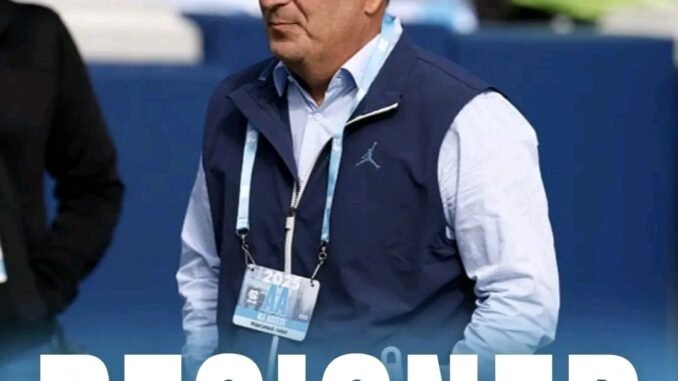
Michael Lombardi’s controversial tenure as the University of North Carolina’s football general manager has officially come to an end.
The university announced that Lombardi has resigned from his position effective immediately, bringing a sudden halt to a turbulent spell that began when he was hand-picked by head coach Bill Belichick in December 2024.
Lombardi, who was earning a base salary of $1.5 million that made him the highest-paid general manager in college football, had been on paid administrative leave since July 27. His departure arrives just days after the Tar Heels opened their 2026 season with a 15–10 victory over TCU in Dublin, Ireland.
“I want to thank Chancellor [Lee] Roberts and Bill Belichick for the opportunity to serve as the GM of UNC Football,” Lombardi said in a statement released through his attorney, Tom Mars. “I have decided it’s best for me to resign my position as GM to allow the team to focus on the ’26 season.”
The resignation stems from an internal university investigation initiated after a human resources complaint was filed against Lombardi by a former employee. While the university’s Office of University Counsel—assisted by outside legal counsel—initially kept specifics under wraps due to standard personnel privacy protocols, the probe quickly cast a long shadow over the program.
Despite Lombardi’s departure, university officials emphasized that the matter is far from closed. In a brief official statement, UNC noted: “The University will continue its ongoing investigation and will consider all appropriate corrective actions responsive to the information it learns”.
Lombardi’s arrival in Chapel Hill was billed as a revolutionary marriage of professional football operations and the collegiate game. Having worked alongside Belichick with the Cleveland Browns and New England Patriots, Lombardi boldly declared that the Tar Heels would operate as “the 33rd NFL team,” attempting to run elite pro-style personnel and scouting departments.
However, the grandiose vision hit heavy turbulence on the gridiron. The Tar Heels stumbled through a disappointing 4–8 campaign in Belichick’s debut season, plagued by five double-digit losses and a stark roster mismatch against seasoned ACC competition. Compounding the on-field struggles, whispers of front-office friction and scrutiny from external compliance bodies regarding Name, Image, and Likeness (NIL) practices began to swirl around the program.
For the university administration, the months-long distraction proved exasperating. In late July, UNC Chancellor Lee Roberts addressed the Board of Trustees, candidly expressing his frustration over the unfolding scandal.
“If something has gone wrong, we want to know about it. If something needs to be fixed, we will be sure to fix it,” Roberts told reporters at the time, calling the ordeal distressing to the entire administration.
As the Tar Heels prepare for the remainder of their 2026 schedule, the program faces significant questions about its administrative structure. Belichick indicated that the coaching staff has been handling day-to-day front-office duties collectively in Lombardi’s absence, utilizing a patchwork approach to absorb the massive workload.
Whether the widening scope of the university’s investigation will uncover deeper structural issues remains to be seen. For now, though, the most prominent and high-priced experiment in college football front-office history has officially been scrapped, leaving Chapel Hill to pick up the pieces.
Leave a Reply